
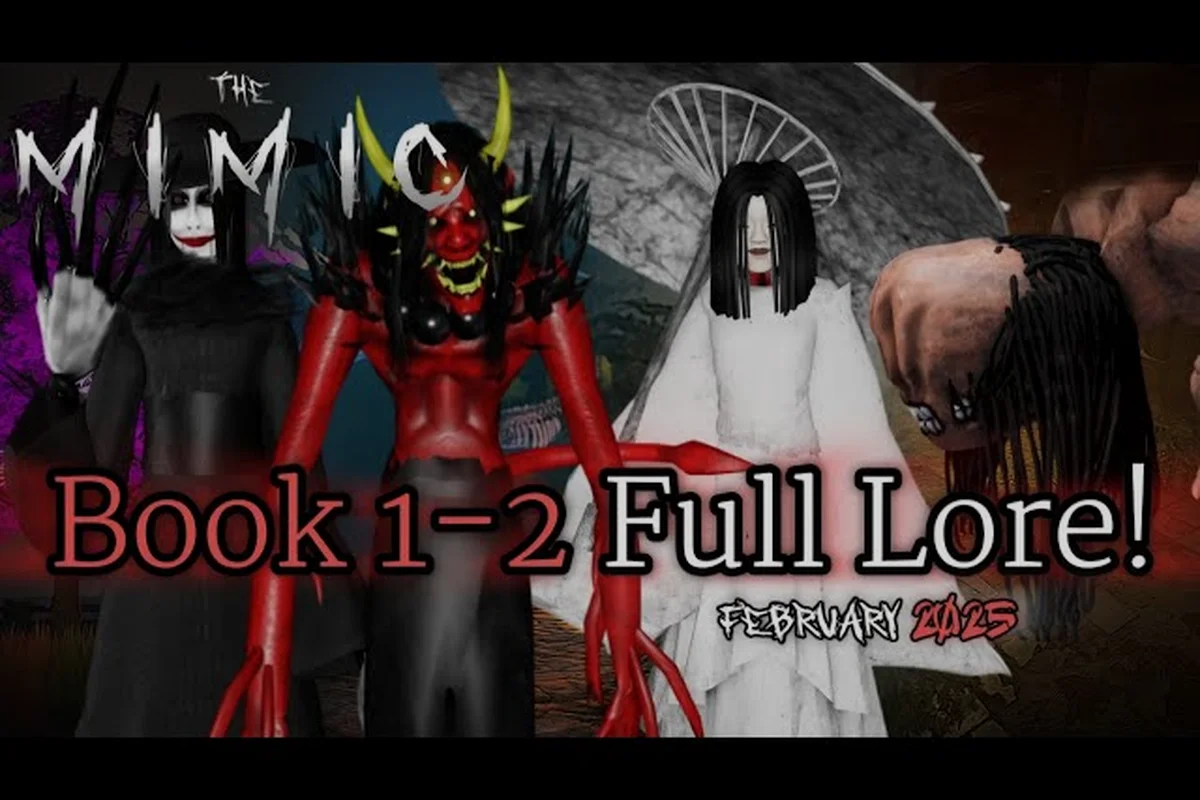
Through Control, Jealousy, Rage, and Rebirth, The Mimic uses each protagonist’s distorted objective to expose a shared mystery: the copied realities are not random set pieces but connected versions of the same encounter. Control turns surveillance into a tool for identifying who altered the simulation; Jealousy makes rival motives distort the player’s reading of allies; Rage converts hostile pressure into escalating combat decisions; and Rebirth reframes repeated deaths as evidence for reconstructing the original event. Together, these four narratives connect the Mimic Book 1 and Mimic Book 2 story threads, showing how the central mystery shifts whenever a character’s perspective changes.
The Mimic Story Framework and Four-Book Sequence
The Mimic story explained is easiest to understand as a sequence of four linked books whose narratives increasingly overlap. Each book presents a different protagonist, yet each character encounters a world that feels designed around imitation, repetition, and inherited expectations. The progression starts with Control, shifts through Jealousy and Rage, and ends with Rebirth, where the earlier books begin to feel less isolated and more like pieces of a larger puzzle.
The central story list therefore consists of four books: Control, Jealousy, Rage, and Rebirth. Their sequence tracks a clear emotional mechanism: the copied environment first rewards obedience through Control, then turns comparison into destructive Jealousy, escalates that pressure into Rage, and finally uses Rebirth to expose how the identities imposed on each protagonist are being repeated and transformed. This four-book progression is what allows details appearing in different protagonists’ stories to function as narrative links rather than incidental similarities.
| Order | Book title | Core emotional conflict | Story function |
|---|---|---|---|
| 1 | Control | Authority and obedience | Establishes the rules of copied environments |
| 2 | Jealousy | Desire and comparison | Shows how emotions distort the imitation |
| 3 | Rage | Anger and defiance | Breaks the expectation of passive submission |
| 4 | Rebirth | Reinvention and identity | Connects the earlier narratives into a larger cycle |
That order matters. Reading the books as unrelated character studies makes their repeated details feel accidental, while treating them as a connected sequence reveals a progression from controlled obedience to open resistance. The complete books overview places each title in the wider narrative order and is useful before diving into individual books.
The core shared mystery
At the center of the story is a reality built from copies. Characters can revisit familiar places, imitate social roles, or inherit expectations that appear to come from outside themselves. The important distinction is that the copies do not merely repeat the past; they reproduce patterns, then give those patterns power over the people trapped inside them.
This idea connects all four protagonists. Each one has a different outward goal, but each must decide whether to keep performing the role assigned to them. The books gradually frame control, jealousy, rage, and rebirth as phases in a struggle over agency rather than unrelated labels.
What the first two books establish
The first two novels contain enough individual story to stand alone, but they also supply the vocabulary used by the later books. Control introduces the machinery of repeated spaces. Jealousy takes that machinery into personal relationships and shows how comparison becomes self-punishment.
By the end of the second narrative, readers have enough evidence to recognize a pattern: every character mistakes an externally modeled version of reality for an authentic one. In Control, the altered spaces make that illusion visible through the removal of physical objects and changing architecture; in Jealousy, private motives externalize suspicion into the comparison of identities and relationships. This progression matters because it turns the Mimic from a single antagonist into a recurring test of perception: the later books examine how the same false model can be shaped by grief, guilt, obsession, or fear, with each emotional focus producing a different version of the story’s central deception.
Control and Jealousy: The Mimic Book 1 and Book 2 Stories
The Mimic Book 1 story begins with a protagonist whose life and identity are structured around compliance. Control is not presented as simple villainy; it is a system of expectations reinforced by routine, status, and the apparent approval of other people. The protagonist learns that following the pattern is safer than questioning it, which makes the surrounding environment feel stable until it begins revealing its copied nature.
The Mimic Book 1 summary centers on a gradual loss of agency. The central character encounters situations in which personal history, institutional rules, and repeated social behavior overlap. The more closely the character imitates the expected role, the more convincing the imitation becomes, but the less room remains for independent choice.
| Story element | Control interpretation | Why it matters |
|---|---|---|
| Repeated locations | Environments reproduce familiar patterns | Routine can conceal fabrication |
| Authority figures | Rules reward compliance | Obedience appears moral but is enforced |
| Personal history | The past is incomplete or inconsistent | Memory cannot provide a stable anchor |
| Central choice | Continue performing or resist | The plot turns identity into an active decision |
Control as a model of enforced normality
Control frames normality as a performance that everyone maintains because no one receives an immediate reward for breaking it. The protagonist’s adaptation is understandable, especially when resistance causes confusion or danger. Yet compliance gradually becomes the mechanism that keeps the copied world stable.
That makes the first book essential rather than merely introductory. It establishes the story’s main question: Is the copied version of a life safer than the uncertain original? The answer is not presented as a simple triumph of disorder. Instead, the protagonist must understand the system before they can resist it without becoming another force that blindly repeats it.
For a chapter-focused breakdown of the opening novel, see Control’s book story and chapter guide. It helps distinguish the protagonist’s immediate struggle from the later implications established by the other three books.
Jealousy turns comparison into a weapon
The Mimic Book 2 story shifts the focus from institutional control to relational obsession. Jealousy begins with a protagonist who measures their worth against another person, whether through desire, rivalry, social approval, or a carefully maintained social role. The setting begins to mirror the character’s fixation, making comparison feel like objective truth.
The Mimic Book 2 summary shows how jealousy accelerates imitation. The protagonist observes another person, copies their traits, and then judges the original self by the copied standard. This creates a vicious cycle: the model appears successful because the protagonist treats imitation as proof of its superiority, while the protagonist’s efforts make the model increasingly difficult to question.
| Comparison point | Control | Jealousy |
|---|---|---|
| Primary pressure | Social and institutional expectations | Another person’s image |
| Copied element | Role, routine, authority | Desire, attention, personal traits |
| Main illusion | Compliance is safe | Comparison reveals worth |
| Emotional cost | Loss of agency | Loss of self-definition |
| Story progression | Learning the system | Seeing how emotion sustains it |
Control establishes the structure; Jealousy reveals its emotional appeal. Both books share the idea that a copy can seem more credible because people continuously reinforce it. Their protagonists also form a contrast: one resists through uncertainty, while the other is trapped by the belief that becoming identical to another person will finally create security.
Rage and Rebirth: Breaking, Rebuilding, and Connecting the Books
The third and fourth books change the emotional tempo. The protagonist associated with Rage does not merely suffer inside the copied pattern; the character actively pushes against it. Rage exposes the weakness in systems that depend on quiet cooperation, but it also carries a danger: destruction can become another script, another predictable response, and another loss of control.
By contrast, Rebirth offers a more complicated direction. It does not simply reverse Rage or restore the world that existed before Control. Instead, it asks whether a person can take ownership of change without pretending that the old identity never mattered. The fourth protagonist must integrate multiple versions of experience rather than choose one cleanly and erase the rest.
Rage and the danger of total refusal
Rage has obvious power because it breaks the emotional passivity found in the first two books. A person who refuses the expected role can expose how fragile the copied order is. Yet the third narrative suggests that pure opposition is not automatically liberation. When rage becomes the only response, the protagonist may repeat a role just as rigidly as the one they rejected.
| Narrative stage | Main force | Potential insight | Potential trap |
|---|---|---|---|
| Control | Compliance | Systems reward obedience | Choosing safety over agency |
| Jealousy | Comparison | Others can define our desires | Treating a model as an ideal |
| Rage | Defiance | Pressure can be challenged | Replacing imitation with automatic revolt |
| Rebirth | Integration | Change can be consciously chosen | Forgetting the patterns that shaped identity |
This is why the sequence feels cumulative. Each book adds an emotional obstacle discovered by the previous protagonists. Control reveals the structure, Jealousy shows the private desire that preserves it, Rage exposes its brittleness, and Rebirth attempts to construct something more flexible.
Rebirth as the fourth movement
The final book’s title promises renewal, but its narrative meaning is not a clean reset. Rebirth means taking responsibility for what happens next after the copied reality has been exposed. The protagonist cannot simply return to a previous state, because the earlier books have already shown how nostalgia can conceal another form of submission.
That is also why Rebirth provides the strongest foundation for a story recap. It can refer back to the emotional logic established by the first three protagonists without merely repeating their events. The four books form a circular model of recognition: a person observes a pattern, imitates it, suffers under it, and eventually learns whether transformation is possible.
The chapter overview for Jealousy, Rage, and Rebirth provides more detail on the later books, including how their protagonists and environmental patterns develop. Across these four books, the changing settings are more than a backdrop: each one externalizes the protagonist’s copied behavior, turning familiar places into evidence of how Mimic-style recognition can be accepted, resisted, or revised. Comparing Jealousy, Rage, and Rebirth therefore clarifies not only the four-part character arc, but also why the final environment cannot restore the original world without confronting the patterns the protagonists previously reproduced.
Connections Hidden Across The Mimic Stories List
The four stories connect through repeated roles, altered settings, and shifting versions of the same emotional trap. The connections are not limited to one character appearing in another book. More often, they work through structural echoes: a room repeats a relationship, a ritual reproduces authority, and a new protagonist inherits a lesson from an earlier story.
The stories list becomes more meaningful when read by function. Control supplies the foundational system, Jealousy examines private attachment, Rage tests direct opposition, and Rebirth explores conscious reinvention. Each title contributes a different answer to one central question: what does it mean to become the person who performs your life?
Character roles and changing perspectives
A changing point of view does more than add variety. It prevents readers from treating the original protagonist as the only person capable of recognizing the truth. Another character may display the same behavior while appearing innocent because the framing has changed. This encourages readers to compare motives and outcomes rather than simply judging whether a decision serves the first lead character.
| Shared pattern | Control | Jealousy | Rage | Rebirth |
|---|---|---|---|---|
| External model | Authority | Rival or admired person | Oppressive order | Past identity |
| Initial response | Submit | Copy | Resist | Integrate |
| Hidden cost | Loss of will | Loss of identity | Loss of control | Loss of innocence |
| Narrative progress | Awareness begins | Pattern repeats | Pattern breaks | Pattern transforms |
The table makes the relationship between the books clear: each protagonist acts on the same basic problem with a different emotional strategy. Control submits, Jealousy imitates, Rage refuses, and Rebirth attempts to transform. None of those strategies is completely useless, but each becomes destructive when treated as the only possible response.
Places that remember differently
Locations in the four books behave almost like characters. They repeat details that seem familiar, yet the meaning changes with each visitor. A place controlled by one protagonist may become a place of comparison for the next, and a space associated with rage can later appear as a memory that must be reassessed rather than inherited.
This structure makes the novels feel connected without requiring every link to be explicit. Readers who want a broader view of the setting can consult The Mimic locations list, while focusing on the books shows how a location’s emotional function changes between narratives.
Why the fourth book carries the largest implications
Rebirth can change the meaning of earlier events because it reveals which details were temporary expressions of a pattern and which details were structural. An angry outburst may look like evidence of resistance, yet Rebirth can show that true agency requires a response other than explosion. Likewise, jealous copying may look like personal weakness, but the second book connects it to a larger process of imitation.
This retrospective design also makes the four books suitable for reread. The first pass emphasizes individual character arcs, while the second pass reveals how the books comment on one another through emotion, setting, and choice. A useful reading order therefore matters more than simply identifying the correct first chapter.
A Practical The Mimic Story Recap by Character Choice
A story recap is most useful when it identifies the central choice each protagonist faces. The characters are not all trying to reach the same destination, so ranking them by “best decision” would ignore the books’ different goals. Instead, compare how each character responds when reality appears to imitate itself.
The practical order can be grouped into three questions. First, identify the role the protagonist accepts, such as the obedient participant in Control, the ambitious imitator in Jealousy, the defiant opponent in Rage, or the reinvented individual in Rebirth. Second, determine which emotional force sustains that role: safety and approval, desire and comparison, anger and frustration, or memory and attachment. Third, observe whether the final action breaks, repeats, or transforms the pattern, because that climax—not the protagonist’s initial intention—reveals what the Mimic has exposed about self-definition.
| Book | Initial role | Force sustaining it | Climactic direction |
|---|---|---|---|
| Control | Obedient participant | Safety and approval | Recognize the system |
| Jealousy | Ambitious imitator | Desire and comparison | Confront self-definition |
| Rage | Defiant opponent | Anger and frustration | Choose what resistance means |
| Rebirth | Reinvented individual | Memory and attachment | Integrate change |
Track plots, repeated places, and choices across passes
For the first pass, follow the present-day plot without assuming every narrator is reliable. For the second pass, track each place that recurs or feels slightly wrong. For the third pass, compare the choices in sequence and ask whether the fourth protagonist solves a problem the first three only described.
This method makes the books readable even without a strict release-order assumption, because it focuses on relationships between themes. It also prevents the fourth title from feeling like a separate conclusion. Rebirth becomes the point where earlier characters’ mistakes, warnings, and partial victories gather new meaning.
Interpreting the copied worlds
The copied environments should not be treated as random horror set pieces. They function like physical versions of the characters’ inner models. Control’s environments preserve hierarchy, Jealousy’s reflect and distort social comparison, Rage’s become volatile, and Rebirth’s rearrange inherited pieces into a different possible reality.
That interpretation also explains why the books can share motifs without becoming repetitive. A repeated hallway, classroom, office, or domestic space is not important merely because it returns; it is important because each narrative projects a different meaning onto the same copied structure.
The Mimic Story Explained: What the Four Books Mean Together
The Mimic story explained as a whole is a study of how identity can be authored by patterns outside the self. The first book shows the pattern operating through control, the second through comparison, the third through open revolt, and the fourth through the difficult work of choosing a new form. The narrative does not reject identity or change; it asks who makes the decisions that determine either one.
That interpretation preserves each novel’s distinct mood while acknowledging their common architecture. Control is measured and institutional, Jealousy is intimate and destabilizing, Rage is forceful and volatile, and Rebirth is reflective without becoming passive. The emotional shift is the clearest evidence that the books belong to one connected story.
Key lessons from the connected arc
Across The Mimic’s connected novels—Control, Jealousy, Rebirth, and the fourth installment—each narrative adapts a recognizable social pattern into a new test of identity, choice, and consequence. For example, a controlling system can reproduce itself whenever a character responds to coercion with a different kind of domination. The sequence matters: Control establishes the framework, Jealousy examines how comparison distorts perception, and Rebirth brings inherited experience into conflict with personal agency. Read in order, these books turn recurring story mechanics into a progression rather than four separate cautionary tales.
-
Repeated behavior is not the same as inherited truth. A pattern may feel natural because it has been performed often.
-
Resistance requires direction. Breaking a system is only the first stage; rage can become another imposed identity.
-
Comparison distorts the original. Another person becomes a model, and the protagonist forgets that a model is only a selected version of reality.
-
Inheritance and agency can coexist. Characters can carry past experiences without allowing the past to choose every next action.
-
A meaningful conclusion transforms the pattern. The final book gains strength because it resolves through integration rather than simple restoration.
These lessons also explain why the stories reward attention to sequence. Reading Jealousy immediately after Control makes their shared architecture visible: a controlling system in Control reappears in Jealousy through comparison, where another character becomes a model for identity and choice. Reading Rebirth last adds a third layer, because its final protagonist must integrate inherited experience with personal agency, turning earlier patterns into commentary on whether the cycle can actually be broken.
A final reading interpretation
The strongest conclusion is not that all characters were manipulated by one hidden villain. It is that everyone can reproduce a reality through compliance, imitation, resistance, or storytelling, and therefore everyone carries partial responsibility for what that reality becomes. The books repeatedly distinguish appearing free from being genuinely able to choose.
This is also why the books resist a simplistic victim-versus-puppet interpretation. Characters make choices, but the environment rewards certain choices and makes others costly. Their freedom is limited without becoming fictional, while their mistakes still matter. Rebirth matters because it turns that tension into the central question of the series: not whether a person can escape imitation, but whether they can become a more deliberate participant in reality.
Frequently Asked Questions
What is the order of the four books in The Mimic?
The sequence is Control, Jealousy, Rage, and Rebirth. Reading in this order lets the shared reality become progressively clearer: Control establishes control, Jealousy examines comparison, Rage explores defiance, and Rebirth brings those emotional lessons into a connected conclusion about change and agency.
How does The Mimic Book 1 story end?
The Book 1 story resolves through recognition rather than a simple escape. Control’s central lesson is that obeying an assigned role can make the copied environment stronger, so the ending emphasizes awareness of how identity and surroundings can reinforce one another. That realization becomes essential to understanding the three books that follow.
Is Jealousy directly connected to Control?
Yes. Jealousy develops the same basic idea of imitation through personal relationships rather than formal authority. Control shows a protagonist adapting to imposed roles, while Jealousy shows someone copying another person and then comparing every aspect of life against that model. The second book expands the first book’s central conflict.
Do Rage and Rebirth belong to the same storyline as the first two books?
They continue the same overarching story. Rage challenges the copied order through open resistance, while Rebirth considers how to change without merely repeating another rigid role. Together, they form a progression from acceptance through defiance toward conscious reinvention, connecting all four books through the central struggle over agency.
What is the main theme of The Mimic story recap?
The main theme is the relationship between imitation and agency. Across the four books, characters accept assigned identities, copy other people, reject established roles, or attempt to reinvent themselves. The connected story asks whether a person can recognize a copied reality and still make deliberate, meaningful choices within it.