
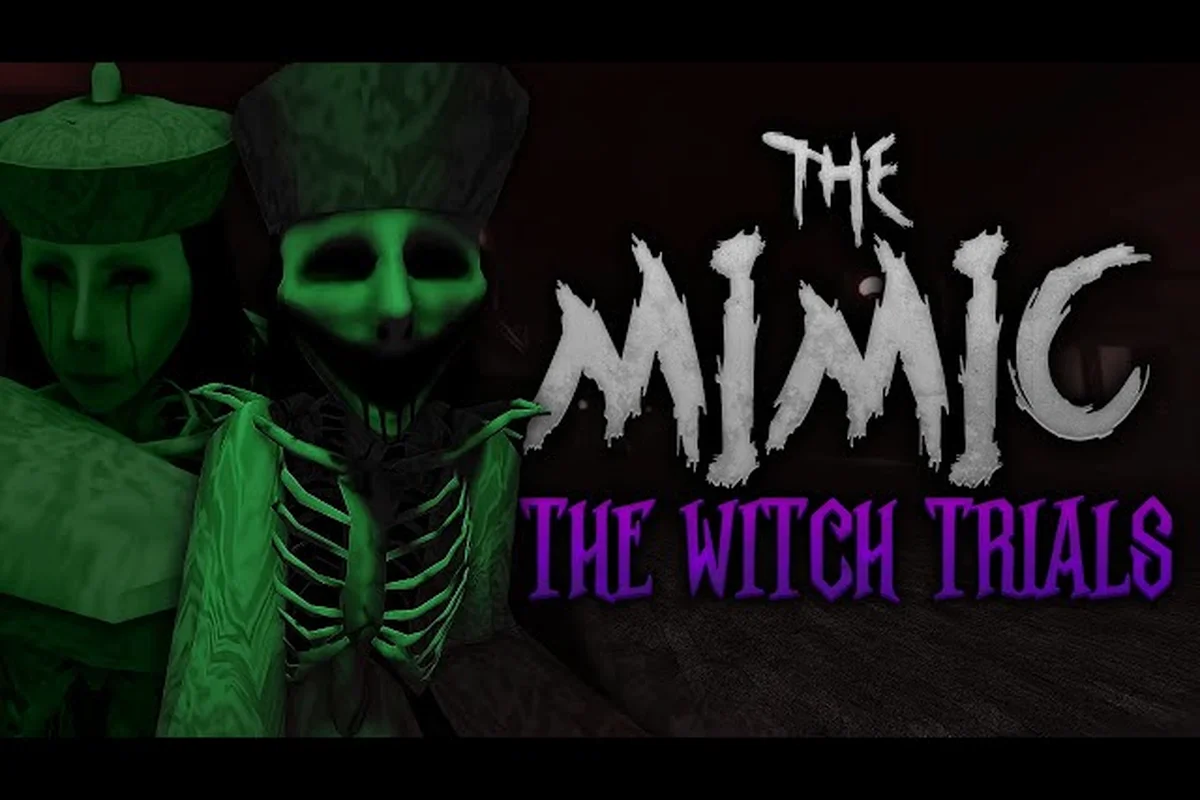
The Mimic how to play Witch Trials centers on completing altered objectives while holiday-themed monsters hunt you across decorated maps. Knowing the objective flow, escape priorities, and seasonal rules turns each round into a controlled survival challenge rather than a guessing game.
The Mimic how to play Witch Trials: Objective Flow
Witch Trials use the same broad trials structure shown in community gameplay footage from Frogs Pond’s Halloween Trials update video: objectives can change, maps receive a seasonal theme, and monster behavior may differ from ordinary runs. The exact Witch Trials task can vary by version, so always read the current round instructions rather than assuming that every event uses the same delivery or collection format.
The essential loop has four stages: enter the map, locate the active task, survive while completing it, and reach the exit before the round ends. A task can appear complete only after an interaction, pickup, or delivery, which means merely reaching the marked area may not be enough.
| Trial stage | What to check | Common mistake |
|---|---|---|
| Round start | Current task and exit condition | Ignoring the instructions panel |
| Search phase | Required item, room, or character | Leaving the likely search area too early |
| Interaction phase | Hold, carry, activate, or deliver | Moving before the interaction finishes |
| Escape phase | Exit route and remaining threats | Treating completion as automatic survival |
Reading the objective correctly
Objective language determines the action required. “Collect” generally means finding the named item, while “deliver” means carrying it to the correct destination. “Activate” tasks require interacting with a device, and “survive” tasks may make movement more important than item collection. Since wording and stage prompts can change between versions, treat the on-screen text as the final authority.
Tracking the round state
Watch the task indicator, timer, and interaction prompts together. If the objective changes after a pickup, assume that a second stage has started rather than immediately heading for an exit. This is especially important in The Mimic Halloween Trials and The Mimic Christmas Trials, where festive decoration can make key devices and interactable objects harder to distinguish. A practical checklist for every round is:
-
Confirm the current objective before entering the building.
-
Note whether the task requires an item, location, interaction, or time survival.
-
Identify the exit while the monster is still far away.
-
Complete the interaction fully before moving.
-
Break line of sight after the objective changes.
Witch Trials Holiday Rules and Seasonal Variations
The holiday presentation changes more than the scenery. Seasonal versions can add themed maps, adjusted monster presets, altered objectives, and visual distractions. The Mimic Halloween Trials guide should therefore focus on reading the environment instead of memorizing one permanent layout, while The Mimic Christmas Trials guide requires the same caution because decorations may conceal useful objects or block sightlines. These are seasonal presentation traits, not guaranteed numerical changes. Specific timers, monster speeds, and objective assignments may vary by platform or version, so check the latest event information before planning a difficult run.
| Seasonal variant | Main visual theme | Practical rule change |
|---|---|---|
| The Mimic Halloween Trials | Pumpkins, candles, and darker decoration | Expect darker rooms and stronger light-and-shadow contrast |
| The Mimic Christmas Trials | Snow, presents, and festive lighting | Watch for red-and-green objects that resemble props |
| The Mimic Nightmare Circus | Circus props and arena-like environments | Treat exposed routes as risky because sightlines may be unusually open |
| Winter Nightmare variant | Snowy or frost-covered presentation | Keep moving between similarly shaped cover points |
Seasonal decoration and camouflage
Holiday props can act as visual noise, but they also reveal where designers want players to look. Bright decorations often frame an important device, while dark corners may conceal both an interactable and a monster. The Holiday Prop Masking effect works in both directions: it gives cover in busy rooms and makes a quiet corner suspicious.
Move your camera independently from your character. A slow camera turn can reveal a device or monster before you commit to a route. Players who rely only on forward movement often step directly into danger because the useful information was visible just outside the center of their view.
Choosing the right seasonal version
Start with the version matching the group’s experience and available time. Solo players may prefer shorter or more predictable objectives, while coordinated groups can handle tasks that divide attention between distant rooms. The Nightmare difficulty overview explains how tougher settings change the risk of mistakes, especially when the monster also gains greater detection pressure.
The Mimic Halloween Trials Map Strategy
The Halloween build favors moments of surprise because pumpkins, candles, and uneven lighting break up familiar rooms. In the footage by Frogs Pond, the core trial structure shows why the event is best understood through Objective Transformation and Holiday Rule Adaptation rather than a fixed checklist.
Map entry and early search
Spend the opening seconds establishing the nearest rooms, possible exits, and the direction from which the monster last appeared. Do not begin with the objective if it places you directly in the monster’s path. The best starting search area is often one with two exits, because a failed attempt then costs only a short repositioning rather than a complete reset.
| Early decision | Better choice | Why it helps |
|---|---|---|
| First search area | Nearby room with two exits | Preserves a retreat route |
| First objective | Non-defended interaction | Creates time to learn the monster pattern |
| Lighting choice | Adequate but not excessive | Improves visibility without exposing your position |
| Group formation | Small overlapping groups | Reduces wasted coverage and supports revives |
Reading monster movement
The key skill is identifying whether the monster is patrolling, investigating, or chasing. A patrol has a repeatable route, an investigation reacts to a sound or brief sighting, and a chase follows your position once it confirms your presence. Avoid sprinting whenever you see movement; a sudden sprint can reveal you even when the monster has not fully locked on.
Listen for positional changes before turning corners. A sound from the same room may indicate a repeated footstep, whereas a distant sound may mean the monster changed direction. Keep short-range vision focused on the doorway you are entering and save wider camera checks for rooms that appear empty.
Objective priority under pressure
Certain objectives should be abandoned temporarily: long carries, repeated activations, and tasks requiring a return trip to a known danger zone. Collect smaller items first, complete quick interactions, and save the most exposed delivery for last only if the exit remains accessible. A useful priority order is quick interaction, nearby pickup, distant pickup, exposed delivery.
The Mimic Christmas Trials Map Strategy
Christmas maps combine cheerful lighting with potentially deceptive scenery. Presents, wrapped objects, and snow effects can resemble loose props, while intense decoration makes it harder to identify a closed door from an open one. The core rule remains simple: complete the active task, survive its transition, and escape without allowing the objective to reset you into danger.
Use cover without becoming trapped
Choose cover that lets you see an approach before entering. A decorative present beside a doorway may hide you, but it can also place you beside the monster’s preferred exit. A better hiding place has two approach angles, enough space to turn without clipping, and a nearby escape route. The hiding spots guide explains how to evaluate those positions in other maps using the same principles.
| Cover quality | Characteristics | Trial use |
|---|---|---|
| Strong | Multiple exits, clear sightlines, room to pivot | Good for recovering after an objective change |
| Moderate | One main exit plus a useful prop | Fine for a short break, not a final hiding place |
| Weak | Dead end or directly beside the entrance | Avoid unless it is the only way to break pursuit |
Manage noise and movement
Wool, snow, and props do not automatically make you silent. Movement speed and surface context can influence noise, but visual exposure remains important. Move at a controlled pace around possible monster patrol points and sprint only when a confirmed chase begins. If teammates are nearby, spread their noise in different directions instead of clustering in the same hallway.
Escape through familiar service routes
Service corridors, closets, and secondary exits are valuable because the monster often focuses on obvious navigation paths. Memorize how the exit connects to nearby rooms rather than memorizing the entire building. When the objective completes, identify the fastest route that allows you to check doorways without standing directly in the open.
The Mimic Nightmare Circus Guide
The Mimic Nightmare Circus is a separate seasonal game mode with its own location identity, so its objectives and map layout should not be treated as a direct Witch Trials copy. The related Nightmare Circus mode guide provides focused information about that mode. It is still useful for comparing how seasonal presentation changes navigation, visibility, and threat priorities.
The circus environment creates Open-Arena Exposure because a large central space may contain several routes but offer little sustained cover. Players can escape in different directions, yet every route also gives the monster another angle from which to approach. The safest pattern is to identify the exit from the arena before committing to the objective.
| Arena condition | Main risk | Better response |
|---|---|---|
| Central objective exposed | Monster can watch every approach | Use props as temporary visual breaks |
| Multiple open lanes | Pursuit direction is hard to predict | Choose cover with two escape angles |
| Dim perimeter | Hidden monster near the edge | Check corners before entering a lane |
| Crowded group play | Sound and movement overlap | Use assigned lanes rather than following one teammate |
Objective timing in exposed spaces
Start the interaction only after checking both the immediate room and the visible arena perimeter. If a monster approaches, cancel when the game permits and move behind a prop rather than completing the task in the open. The Objective Exposure Penalty is greater in an arena because a failed attempt can cost more time and expose your group to a long chase.
Team roles for the circus
One player can watch the objective, another can monitor the central arena, and the third can cover the exit route. Keep roles flexible because the objective may move between phases. In solo play, separate the same tasks across time: explore first, activate second, and escape without looking back until the exit is reached.
Surviving Every Witch Trials Objective
Survival depends on protecting the objective sequence, not on avoiding the monster at all costs. A player who hides immediately may preserve health but fail the timer, while a player who rushes every task can complete the round with too little time to escape. The strongest approach balances task efficiency, visibility control, and retreat readiness.
A reliable round procedure
-
Read the current objective and note every required stage.
-
Find the task area without entering the monster’s probable approach lane.
-
Complete the quickest safe interaction first.
-
Break sight after the task updates, because completion may trigger a new monster action.
-
Move through cover toward the exit while checking doors and elevated positions.
-
Recheck the exit before leaving, since the monster may wait near the apparent finish.
| Risk | Early warning | Corrective action |
|---|---|---|
| Being spotted | Monster stops and turns directly toward you | Break sight through a nearby doorway or prop |
| Sound investigation | Monster changes route without seeing you | Stop moving briefly and let it pass |
| Objective transition | New prompt, sound, or indicator appears | Stop moving and verify the next requirement |
| Exit trap | Monster remains near the finish | Wait, create distance, then use another route |
| Team separation | Missing teammate or crossed path | Regroup at a defensible landmark |
Prioritize information over perfect hiding
A player who understands where the monster went can choose a safer objective route. A player who only watches the monster may repeatedly hide while the task expires. Use Threat Memory to remember the last confirmed direction, then compare it with the objective’s location. If the objective is behind the monster, wait for it to pass or take the longer approach.
Handle mistakes without panic
A failed interaction or dropped item does not automatically end every run. Reset calmly: identify where the monster was last seen, choose the route that avoids that area, and resume the task from its current state. Panic sprints create extra sound and make corners harder to control.
The Mimic Witch Trials Guide to Team Coordination
Cooperation matters because one person can watch threats while another completes the objective. The best groups divide attention by function rather than simply remaining together. In tight rooms, however, stacking creates noise and makes it difficult to react when a monster appears behind the group.
Communication priorities
Keep callouts brief and action-based. Useful examples include “objective ready,” “moving left,” “entering room,” and “exit blocked.” Avoid long explanations during a chase. When communication cannot be heard, use agreed visual cues such as pointing toward danger or gathering at a safe landmark.
| Team arrangement | Strength | Weakness | Best use |
|---|---|---|---|
| One tight group | Easy mutual protection | Shared noise and narrow escape | Quick objectives |
| Two separated pairs | Wider monitoring | Can lose sight of each other | Search-heavy rounds |
| Three loose lanes | Strong area control | Confusing objective assignment | Larger maps |
| Objective plus lookout | Efficient task handling | Watcher may be isolated | Open or arena layouts |
Recovering after separation
Agree on a fallback meeting point before beginning. A central, defensible landmark is usually better than the objective itself because the objective can change or become unsafe. If a teammate is downed, determine whether helping is possible without leading the monster into the rest of the group. Players who need additional routes can consult the The Mimic locations guide, which explains how major locations influence navigation and hiding decisions. That knowledge helps teams choose meeting points with more than one way out.
Event awareness
Seasonal events can change maps and rewards, so check the current event notes before each session. The latest The Mimic updates overview can help players identify holiday changes and related adjustments. This matters for The Mimic Halloween Trials and The Mimic Christmas Trials because an old route guide may no longer match the active event version.
Frequently Asked Questions
Can The Mimic how to play Witch Trials be completed in solo?
Yes, Witch Trials can be approached solo because the core objectives are designed around individual navigation and survival. Prioritize quick interactions, observe the monster before committing to a room, and avoid objective routes that have no retreat. Solo play leaves you with fewer distractions, but it also removes the teammate who would otherwise watch your back.
What changes in The Mimic Halloween Trials compared with regular trials?
The Halloween version uses a seasonal presentation that may include transformed objectives, themed maps, and altered monster behavior. The dependable rule is to read the current objective and observe movement rather than relying on a permanent route. Dark lighting and decorative props can obscure both interactables and enemies.
Is The Mimic Christmas Trials harder than the Halloween version?
Difficulty can vary by version, but Christmas maps may contain brighter decoration, wrapped props, and snowy visual effects that make object recognition harder. The stronger challenge is often environmental confusion rather than a guaranteed stat increase. Keep your camera moving and test doors before committing to a narrow route.
Should players hide after completing a Witch Trials objective?
Usually not immediately. Completion can change the objective, open the exit, or alter the monster’s behavior, so leaving the area without checking the new state may be worse than staying briefly. After confirming the update, break line of sight and take a covered route toward the exit while continuing to watch behind you.
Does the The Mimic Nightmare Circus guide apply to Witch Trials?
Only as a comparison. The Nightmare Circus has its own map identity and mode rules, so use its guide for circus-specific tactics rather than assuming the same objective locations. The transferable lessons are to watch open approaches, protect the exit route, and split team attention between the task and the surrounding arena.